

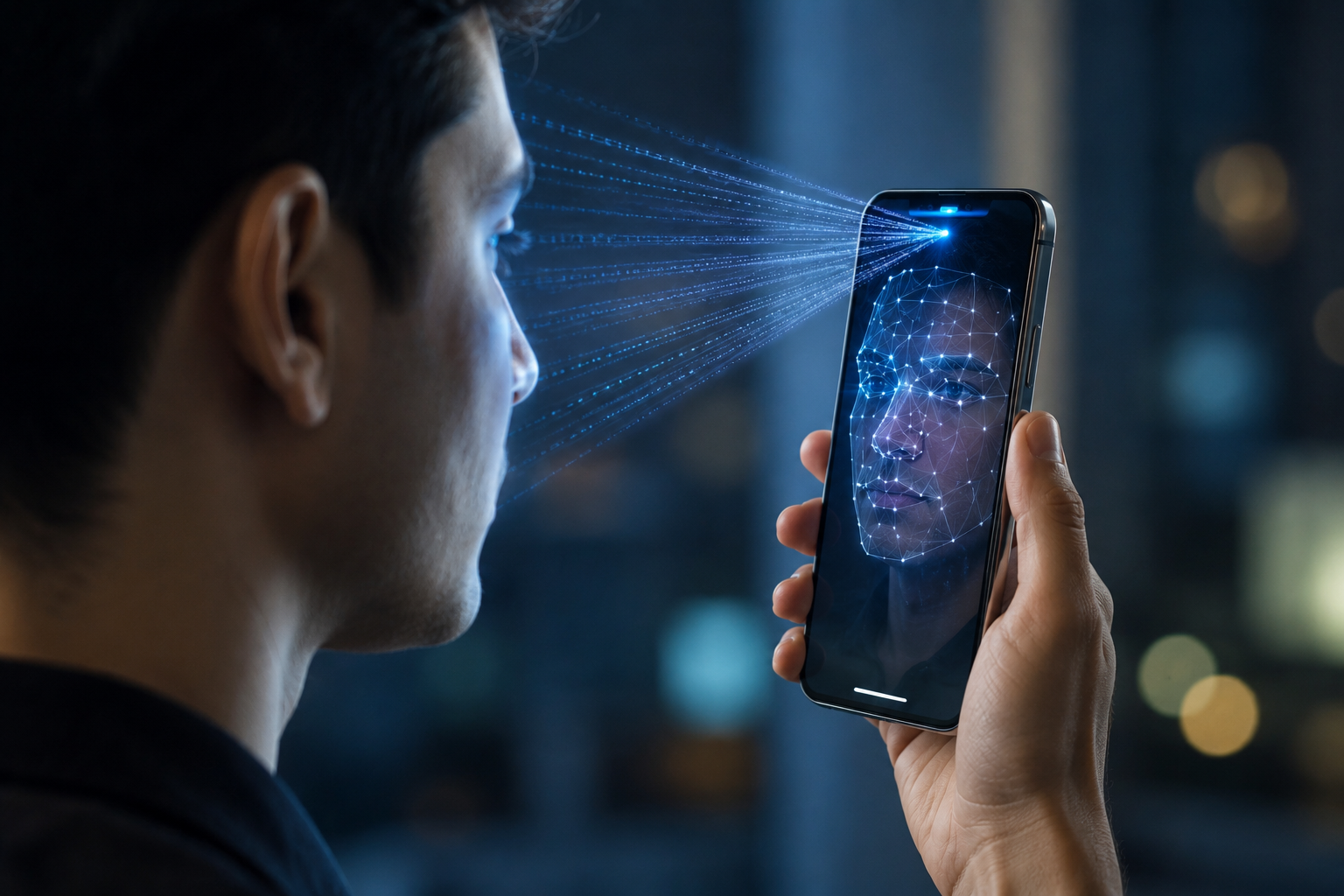
The arrival of Apple Face ID completely transformed the way people unlock their smartphones. Before facial recognition became common, users mostly relied on passwords, PIN codes, or fingerprint scanners to protect their devices. Apple introduced something different, a smarter and more secure way to identify users using facial mapping technology.
Today, millions of iPhone users unlock their devices simply by looking at the screen. The process feels effortless, but behind that quick scan lies highly advanced technology working within seconds.
As smartphones continue becoming more personal and important in daily life, Face ID has become one of Apple’s most talked-about security features. From unlocking phones to confirming payments, the system now plays a major role in how users interact with their devices safely and conveniently.
What Is Apple Face ID? – Apple Face ID
Apple Face ID is a facial recognition security system developed by Apple for iPhones and other supported devices.
The technology scans and recognizes a user’s face to unlock the phone, verify purchases, and protect private information. Apple first introduced Face ID with the iPhone X in 2017, replacing the traditional home button and fingerprint scanner on flagship devices.
Unlike basic facial recognition systems that rely only on a front camera, Face ID uses advanced depth-mapping technology to create a detailed 3D model of a user’s face.
This makes the system significantly more secure and accurate.
How Apple Face ID Actually Works – Apple Face ID
Face ID works through a system Apple calls the TrueDepth camera system.
This setup combines several sensors and components that work together in real time. When a user looks at the device, the system instantly begins analyzing facial details.
The process happens in just a few seconds, but multiple technologies operate simultaneously behind the scenes.
The Infrared Camera
One important part of Face ID is the infrared camera.
This camera captures an infrared image of the user’s face, allowing the phone to recognize facial details even in low light or complete darkness.
That is why Face ID continues working at night without requiring bright screen lighting.
Dot Projector Technology
Another key component is the dot projector.
The projector places thousands of invisible dots across the user’s face to create a precise depth map. These dots help the system understand facial structure rather than relying only on flat images.
This added depth information improves security dramatically because photographs alone cannot easily fool the system.
Flood Illuminator Support
The flood illuminator helps the device locate the user’s face quickly.
It works by illuminating the face with infrared light, helping the system operate in difficult lighting conditions.
Together, the infrared camera, dot projector, and flood illuminator form the core of the Face ID system.
Why Face ID Is Considered Secure – Apple Face ID
Security remains one of the biggest reasons behind the popularity of Apple Face ID.
Traditional passwords can be guessed or stolen. Fingerprints may fail under certain conditions. Face ID, however, uses advanced mathematical models of a user’s face instead of storing actual photographs.
Apple states that facial data is securely stored within the device’s Secure Enclave, a protected area inside the processor.
This information never leaves the device and is not uploaded to external servers.
Face ID Adapts Over Time
One impressive feature of Face ID is its ability to adapt gradually to changes in appearance.
For example, the system can still recognize users if they:
- Grow a beard
- Wear glasses
- Change hairstyles
- Use makeup
- Wear hats
The technology learns these minor changes over time while maintaining security.
Protection Against Fake Access
Face ID is also designed to reduce unauthorized access attempts.
The system uses depth mapping and attention awareness features to confirm that a real person is actively looking at the screen.
This makes it harder for someone to unlock the phone using printed pictures or basic images.
How Face ID Improves Everyday Convenience – Apple Face ID
Security is important, but convenience is another major reason why users appreciate Face ID.
Instead of typing passwords repeatedly, users can simply glance at their devices to complete actions instantly.
Face ID now supports many daily tasks, including:
- Unlocking iPhones
- Downloading apps
- Confirming Apple Pay purchases
- Accessing banking applications
- Logging into supported apps
- Viewing sensitive notifications
This creates a smoother and faster user experience.
Faster Access to Apps and Payments
Digital payments have become increasingly common worldwide.
With Face ID, users can verify transactions quickly without manually entering passwords during every purchase. This not only saves time but also improves overall security during payments.
Many banking and financial apps now support Face ID authentication as well.
Face ID and Privacy Concerns – Apple Face ID
Whenever facial recognition technology becomes part of daily life, privacy concerns naturally follow.
Some users worry about how facial data is stored and whether companies can misuse personal information.
Apple has repeatedly emphasized that Face ID data remains encrypted and stored locally on the device. According to the company, the information does not get uploaded to cloud servers or shared with third parties.
This privacy-focused approach helped Apple build user trust around Face ID technology.
Face Data Stays on the Device
One important privacy feature is local data storage.
The facial map created during setup remains inside the device’s Secure Enclave. Even Apple itself cannot directly access the stored facial data.
This design helps reduce security risks related to external breaches or server hacks.
Situations Where Face ID May Not Work Perfectly – Apple Face ID
Although Face ID is highly advanced, it is not completely flawless.
Certain conditions can temporarily affect performance.
For example:
- Heavy face coverings may block recognition
- Some sunglasses can interfere with infrared scanning
- Extreme lighting conditions may slow detection
- Very dramatic appearance changes can require passcode verification
In these situations, the device may ask users to enter their passcode manually.
However, Face ID generally remains reliable in most daily environments.
How Face ID Changed the Smartphone Industry – Apple Face ID
The launch of Apple Face ID influenced the entire smartphone market.
After Apple introduced the technology, many smartphone companies started investing heavily in facial recognition systems of their own. Some brands focused on software-based solutions, while others developed advanced hardware systems inspired by Apple’s approach.
Face ID also accelerated the shift away from physical home buttons and fingerprint scanners on premium devices.
Today, facial recognition has become a standard feature across many flagship smartphones.
The Rise of Biometric Security
Face ID helped make biometric authentication more mainstream.
Consumers now expect smartphones to offer:
- Faster unlocking
- Stronger privacy protection
- Seamless authentication
- Secure digital payments
This shift has pushed smartphone security technology forward significantly.
Apple Continues Improving Face ID Technology – Apple Face ID
Apple continues refining Face ID with each new iPhone generation.
The company regularly improves:
- Recognition speed
- Low-light performance
- Accuracy
- Security protections
- Device integration
As artificial intelligence and machine learning continue evolving, Face ID technology may become even smarter in the future.
Experts believe facial recognition could eventually support more personalized experiences across devices and services.
Final Thoughts – Apple Face ID
The success of Apple Face ID shows how modern technology can combine security and convenience in everyday life.
What once felt futuristic has now become a normal part of smartphone usage for millions of people worldwide. By using advanced sensors, infrared technology, and depth mapping, Apple created a facial recognition system that feels both fast and secure.
From unlocking devices to authorizing payments, Face ID continues changing how users interact with smartphones every day.
As mobile security becomes increasingly important, technologies like Face ID will likely remain central to the future of personal digital protection.
Read more interesting articles here: Infinix GT 50 Pro
